
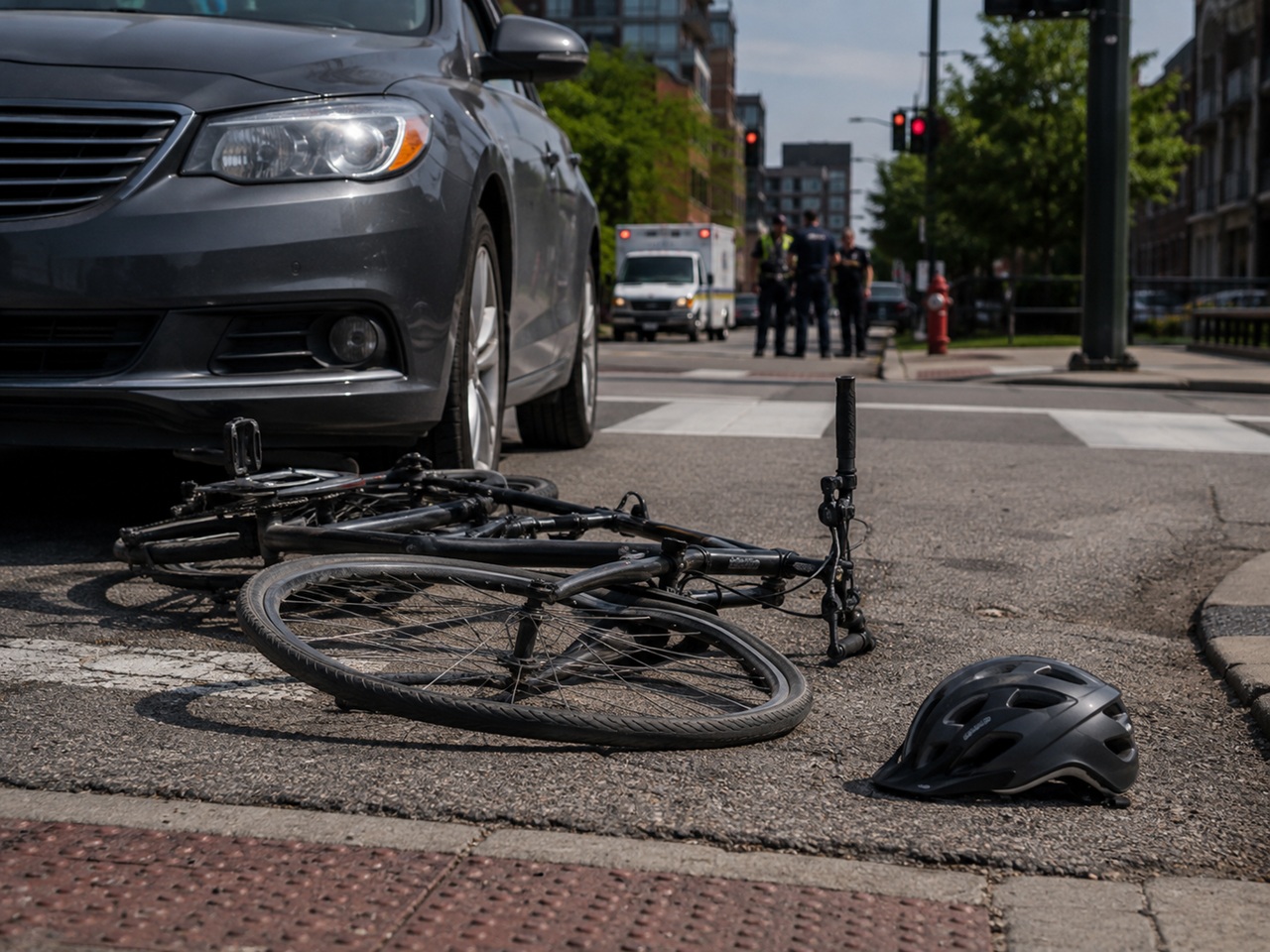
A Slow-Moving Vehicle Can Still Cause A Serious Crash
A driver eases out of a Chicago parking lot and clips a cyclist's front wheel. A passenger opens a car door into a bike lane while the vehicle is completely stopped. A driver makes a slow right turn across a cyclist's path at an intersection. None of these crashes requires highway speed to cause a serious bicycle accident.
That's because the car's speed tells only part of the story. Even relatively minor contact can knock a cyclist off balance. Once that happens, the rider may go over the handlebars, land on an outstretched arm, strike their head against the pavement, hit a curb, or get pushed into another vehicle. The second impact can cause far more harm than the initial contact with the car.
Our award-winning Chicago bicycle accident attorneys at Keating Legal have represented hundreds of injured cyclists and recovered tens of millions of dollars for bicycle crash victims. We know why an insurance company's description of a "low-speed accident" doesn't necessarily tell you anything meaningful about the injuries a cyclist suffered.
Why A Low-Speed Hit Can Still Cause Major Injuries
The first contact is often only the beginning of a bicycle crash.
1
Vehicle Contact
A bumper, mirror, turning vehicle, or opening door disrupts the bicycle's balance or path.
2
Loss Of Control
The cyclist falls sideways, goes over the handlebars, or gets forced toward another hazard.
3
Secondary Impact
The rider's head, shoulder, wrist, back, or face strikes pavement, a curb, a parked car, or another vehicle.
The takeaway: A driver's speedometer doesn't measure what ultimately happens to the cyclist's body.
The Pavement Can Cause More Damage Than The Car
People often picture a serious bicycle accident as a high-speed vehicle directly crushing or throwing a rider. Many crashes don't happen that way.
A five-year study involving 4,144 bicycle-related emergency department visits found that falls actually outnumbered collisions. The researchers found fractures in 34% of the cases, upper-extremity injuries in 36%, and head injuries in 19%.
Those injury patterns make sense when you consider what a cyclist instinctively does during a fall. A rider may extend their arm to protect their face, sending force through their hand, wrist, elbow, or shoulder. Another cyclist may pitch forward and strike the pavement with their head or face.
Unlike someone inside a passenger vehicle, a cyclist doesn't have a seat belt, airbag, steel frame, or crumple zone surrounding the body. Once the bicycle becomes unstable, very little separates the rider from the road.
That's why bicycle accident injuries can include concussions, traumatic brain injuries, fractured wrists and arms, broken collarbones, shoulder injuries, spinal injuries, dental trauma, severe road rash, and nerve damage, even when the vehicle wasn't traveling particularly fast.
A Dooring Crash Proves That Vehicle Speed Isn't Everything
Few crashes illustrate this point better than a dooring accident in Chicago.
The car may not be moving at all.
A cyclist rides beside a line of parked vehicles. Someone suddenly opens a door into the cyclist's path. The rider may hit the door directly, flip over it, slam into the pavement, or swerve into an active traffic lane to avoid it.
Illinois law addresses this exact danger. 625 ILCS 5/11-1407 prohibits opening a vehicle door into moving traffic unless it is reasonably safe and won't interfere with that traffic. Chicago Municipal Code § 9-80-035 imposes the same basic duty.
Chicago law goes even further. Under Municipal Code § 9-4-025, a dooring violation that causes a motor vehicle-bicycle collision can carry a $1,000 fine.
Keating Legal has handled the consequences firsthand. In one case, we recovered $275,000 for a Chicago bicyclist who suffered a concussion after being doored in Lakeview. The recovery exceeded the driver's primary insurance limits after our attorneys identified another applicable insurance policy.
The parked car wasn't speeding. It wasn't even moving. And our client still suffered a brain injury.
Slow Right Hooks And Left Hooks Can Put A Cyclist On The Ground
Chicago intersections can be a cyclist’s worst enemy at any speed, especially when there are five different directions and a handful of blind spots, hundreds of people walking around, and one comically enthusiastic architecture tour.
A driver, distracted or not, can make a right hook by overtaking a cyclist and then turning right across the cyclist's path. The vehicle may already have slowed for the turn, but the cyclist can still hit the side of the car, get swept sideways, or go over the handlebars.
The same problem can happen from the opposite direction during a left-hook bicycle crash. A driver turns left across the path of an approaching cyclist, leaving too little room or time for the rider to avoid contact.
Chicago Municipal Code § 9-16-020 specifically protects bicyclists in both situations. A driver turning left must yield to an approaching bicycle that presents an immediate hazard. A motorist who overtakes a bicycle on the right side of the roadway can't turn right in front of that cyclist until the vehicle has safely cleared the bicycle.
The law doesn't create a "slow-speed exception." A driver still has to yield and turn safely.
Illinois Drivers Still Owe Cyclists The Same Duties At Low Speeds
Illinois traffic law upholds a straightforward principle: bicyclists belong on the road.
625 ILCS 5/11-1502 gives people riding bicycles on Illinois roadways the same rights and, generally, the same duties that apply to drivers of vehicles. 625 ILCS 5/11-1003.1 separately requires every driver to exercise due care to avoid colliding with a bicyclist.
Chicago And Illinois Bicycle Law Snapshot
None of these protections disappear because traffic is moving slowly.
| Driver Duty | Rule | Why It Matters |
|---|---|---|
| Recognize Cyclists' Road Rights | 625 ILCS 5/11-1502 | Illinois gives bicyclists the roadway rights that generally apply to vehicle drivers. |
| Exercise Due Care | 625 ILCS 5/11-1003.1 | Drivers must take reasonable care to avoid colliding with bicyclists. |
| Leave At Least 3 Feet | 625 ILCS 5/11-703(d) | A passing motorist must leave a safe distance of at least three feet and maintain it until safely past. |
| Check Before Opening A Door | 625 ILCS 5/11-1407 / Chicago § 9-80-035 | Drivers and passengers can't open a door into moving bicycle traffic when it isn't safe to do so. |
| Yield While Turning | Chicago § 9-16-020 | Chicago specifically addresses left hooks and right turns across a cyclist's path. |
Passing Too Closely Can Cause A Crash Without Direct Contact
A motorist doesn't necessarily have to hit the bicycle to cause the rider to crash.
Under 625 ILCS 5/11-703(d), a driver overtaking a bicycle must leave a safe distance of at least three feet and maintain that distance until safely past. When another lane in the same direction is available, the current version of the statute also directs drivers to change lanes when practicable and lawful.
A close pass can force a cyclist toward a curb, a pothole, a parked vehicle, or another road hazard. A startled rider may also lose control without the car physically striking the bicycle.
This becomes particularly important in narrow Chicago streets and bike-lane crashes, where inches can determine whether a cyclist continues riding safely or goes to the pavement.
For instance, in a case in the north suburbs near Northwestern University, we obtained a $100,000 policy-limits recovery for a cyclist after a driver failed to provide the legally required three feet of passing space.
Head And Brain Injuries Don't Require A High-Speed Impact
A concussion happens when rapid acceleration, deceleration, or rotation causes the brain to move inside the skull. A cyclist can experience those forces when the head hits pavement after a seemingly modest collision.
A rider may also suffer a brain injury without losing consciousness. Symptoms can include headache, dizziness, confusion, memory problems, nausea, light sensitivity, balance problems, sleep changes, and difficulty concentrating.
That's why a cyclist shouldn't assume they escaped injury simply because the vehicle wasn't moving fast or because they walked away from the scene. Some bicycle-related head injuries don't become obvious until later.
Although Illinois does not have a statewide law requiring bicyclists to wear helmets, local ordinances and municipalities may require children or messenger and delivery bicyclists to wear helmets. But this kind of safety protocol is still recommended. A helmet can reduce the risk of serious head trauma, but it can't prevent every concussion or brain injury. It also doesn't protect a rider's wrists, shoulders, collarbone, spine, knees, face, or other exposed parts of the body.
Insurance Companies May Focus On Speed Instead Of The Injury Mechanism
One of the predictable fights in a low-speed bicycle case concerns causation.
An insurer may cite minor damage to the car. The adjuster may emphasize that the driver was barely moving. They may argue that the cyclist "couldn't have been hurt that badly" in such a small collision.
That argument overlooks what actually happened as a result of the collision.
Vehicle damage doesn't measure the force the cyclist's wrist absorbed while breaking a fall. A scratched bumper doesn't tell you whether someone's head struck asphalt.
The relevant evidence may show that the car clipped a wheel and sent the rider over the handlebars, a door stopped the bicycle abruptly while the rider kept moving forward, or a slow turn knocked the cyclist onto concrete.
This is where medical records, photographs, witness statements, surveillance footage, bicycle damage, helmet damage, road markings, and digital ride data can become particularly important.
Your GPS Data May Help Reconstruct A "Minor" Crash
Many Chicago cyclists record rides through a bicycle computer, smartwatch, phone, Strava, Garmin, or another GPS-enabled device.
That data may help establish the rider's location, direction of travel, speed, route, and sudden stop around the time of impact. In a case where a driver or insurer disputes how the collision happened, GPS evidence from a bicycle crash can help confirm the cyclist's account.
Nearby cameras can matter just as much. Chicago businesses, residences, CTA facilities, intersections, buses, and other sources may capture a crash or the moments immediately before it.
That evidence may disappear quickly. Businesses overwrite surveillance footage. Witnesses forget details. A damaged bicycle gets repaired. Ride data can become harder to retrieve.
A low-speed crash shouldn't lead anyone to treat the investigation casually. In most cases, you can request a business’s surveillance recordings when it relates to an accident you were involved in, although not required by law to cooperate, having a legal team can help secure the footage through legal means.
Illinois Contributory Fault Makes Evidence Especially Important
Insurance companies frequently try to shift at least some responsibility onto the cyclist. In a low-speed case, an adjuster might argue that the rider should have stopped sooner, avoided the door, anticipated the turn, or moved farther away from the vehicle.
Illinois follows contributory fault under 735 ILCS 5/2-1116. If a jury or judge determines that the cyclist's share of fault exceeds 50%, the cyclist can't recover damages. If the cyclist's fault is 50% or less, the law reduces the amount awarded for damages by that percentage.
That makes the evidence behind fault in a Chicago bicycle accident especially important. An insurer shouldn't get to turn "low speed" into "the cyclist must have been able to avoid it" without evidence supporting that conclusion.
Illegal parking, particularly in designated bike lanes, can force cyclists into traffic lanes, increasing the risk of collisions and loss of control for motorists who, through no fault of their own, may have reduced visibility or limited time to react. Delivery vehicles, rideshares, and buses that make frequent stops can create similar hazards and should also be considered as potential third-party sources of liability when evaluating alternative avenues for legal remedy.
Michael Keating Helped Change Illinois Bicycle Law
Keating Legal doesn't simply handle bicycle cases. Our attorneys have helped shape the laws that protect Illinois cyclists.
Founding attorney Michael S. Keating is an avid cyclist and a nationally recognized bicycle law attorney. He serves as Chair of the Bicycle Litigation Committee for the American Association for Justice and on the Board of Managers of the Illinois Trial Lawyers Association. Leading Lawyers has recognized him as a Leading Lawyer, and the National Trial Lawyers has recognized him among its Top 100 Trial Lawyers and Top 40 Under 40.
Attorney Keating also represented the family of cyclist Dennis Jurs and wrote the first draft of Dennis's Law. Illinois enacted that law after a court ruling created uncertainty about whether bicyclists received the same right-of-way protections as motorists. Dennis's Law clarified that bicyclists have those roadway rights.
That background matters when an insurance company tries to reduce a bicycle case to a dent, a speed estimate, or an assumption about how cyclists "should" behave.
Contact Keating Legal If You've Been Injured in Chicago
A bicycle crash doesn't need twisted metal or a high-speed impact to change someone's life. A few seconds of contact can lead to a fractured wrist that requires surgery, a concussion that keeps someone out of work, a shoulder injury that makes daily tasks painful, or a spinal injury that requires months of treatment.
Our award-winning attorneys at Keating Legal have represented hundreds of injured bicyclists throughout Chicago and Illinois, recovering tens of millions of dollars on their behalf. We investigate the entire crash, not just the driver's estimated speed. That means examining how contact occurred, how the cyclist fell, which part of the body struck the ground, which traffic laws applied, and what evidence can establish the actual mechanism of injury.
If you've been hurt in a bicycle collision that an insurance company is trying to dismiss as "minor" or "low speed," contact Keating Legal for a free consultation. We'll review the crash, explain your rights under Illinois and Chicago bicycle law, and fight for the compensation and accountability you deserve.
"Mike and his team really came through for me... It's good to have a seasoned pro like Mike in my corner." - K.M., ⭐⭐⭐⭐⭐