
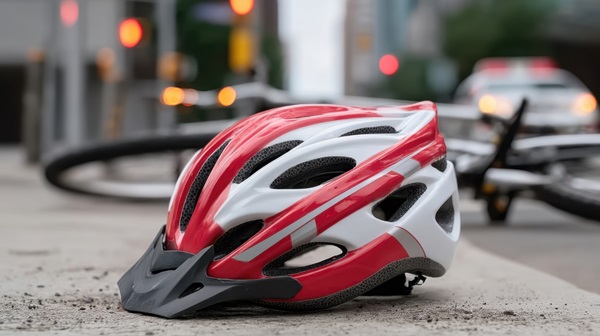
A police report can feel like the final word after a bicycle crash. But for families grieving a loss or riders trying to recover from serious injuries, seeing official paperwork shift blame onto the cyclist can be devastating. And once that narrative is written down, it often shapes how insurers view the case, even when it’s wrong.
The recent death of Steve Bender in Tinley Park is a painful example of how quickly that blame can appear. Despite riding legally on the roadway, wearing visible clothing, and doing nothing improper, early documentation suggested that the cyclist was at fault. It took courtroom testimony and a judge’s direct findings to correct the record and state plainly that the driver was negligent and that the cyclist had every right to be riding where he was. Even with this, the driver was ultimately only charged with driving too fast and not for improperly passing a cyclist.
At Keating Law Offices, P.C., our Chicago bicycle accident attorneys have seen this pattern repeatedly. Police reports are important, but they aren't infallible, and when they get it wrong, injured cyclists and their families aren't just stuck with that version of events.
Police Reports Are Starting Points, Not Final Verdicts
When we talk about a “police report,” typically that is a reference to an Illinois Traffic Crash Report. Police reports are often written quickly, sometimes without full witness interviews, complete scene measurements, or a deep understanding of bicycle law. For example, in Steve Bender’s case, the Cook County Sheriff’s report implied partial responsibility because he was riding in the roadway, even though Illinois law explicitly allows cyclists to do exactly that.
Later, judges made it clear that the implication was wrong.
That distinction matters because insurance companies lean heavily on police narratives. When a report subtly or explicitly blames the cyclist, insurers often treat it as permission to deny claims, reduce payouts, or argue comparative fault.
That’s why pushing back early is critical.
Evidence That Can Overturn a Faulty Police Narrative
When a police report points the finger at a cyclist, the real work begins. Successful challenges are built on evidence that tells the fuller story of what actually happened.
Here’s the kind of proof that can shift the case:
- Crash Damage and Vehicle Positioning: In the Bender case, the front-end damage to the SUV and the lack of braking evidence contradicted the driver’s claim that the cyclist suddenly swerved. Physical damage often tells a more honest story than statements made after the fact.
- Roadway Design and Shoulder Conditions: Narrow shoulders, rumble strips, and unsafe edges force cyclists into travel lanes. Photographs, measurements, and roadway records can explain why a cyclist was riding where they had every right to be.
- Witness Accounts That Were Missed or Minimized: Independent witnesses are frequently overlooked or interviewed late. When they’re located and documented properly, their testimony can directly refute initial assumptions.
- Traffic Law Clarifications: Judges in Illinois have repeatedly affirmed that bicycles are vehicles with the same rights to the road as other vehicles. Bringing that law into the record matters, especially when officers or reconstruction reports misapply it.
Once this evidence is assembled, the tone of a case often changes fast.
Section 11-703 of the Illinois Vehicle Code
As currently written, the Illinois Vehicle Code only allows a motorist to be charged for improperly passing a bicyclist (or pedestrian, equestrian, or carriage) if the conduct rises to the level of recklessness. That is an extraordinarily high bar. It is far higher than ordinary negligence—and far higher than what is required throughout the rest of the same statutory section.
In practical terms, this heightened standard handcuffs law enforcement and prosecutors. Even where the evidence clearly establishes unsafe driving, charges cannot move forward unless the conduct meets the legal definition of “reckless.” That gap in the law has had devastating consequences.
Illinois residents saw this in two fatal Illinois crashes.
David Powell, a Champaign-area husband and father of two school-aged children, was killed in April 2020 when a passing semi-truck struck him while he was riding. By all accounts, he was doing nothing wrong. Yet despite probable cause supporting negligence, authorities concluded they could not meet the reckless standard required under the statute.
Similarly, Judge Ramon Escapa was killed in June 2020 while riding with his wife, Michelle. A veteran, former Schuyler County State’s Attorney, and Circuit Court Judge in the Eighth Judicial Circuit, he was also a dedicated bicyclist and a board member of Ride Illinois. I had the opportunity to meet him. He was an impressive and committed public servant. He leaves behind school-aged children.
In both cases, law enforcement indicated there was probable cause for negligence—but not for recklessness. As a result, no charges were pursued. These were fatal crashes. There was no evidence that either bicyclist was contributorily negligent. Yet the statutory framework prevented accountability.
That is a public safety problem.
It is also a statutory inconsistency. The remainder of the relevant section of the Illinois Vehicle Code applies a negligence standard. There is no clear legislative history explaining why passing a vulnerable road user would require proof of recklessness instead. Vulnerable road users deserve at least the same level of legal protection found elsewhere in the Code—not less.
When the law sets the bar unrealistically high, it does not promote safety. It undermines enforcement. A negligence standard would not criminalize accidents; it would simply allow prosecutors to pursue cases where drivers fail to exercise due care around bicyclists and other vulnerable road users.
The goal is straightforward: accountability, consistency within the statute, and safer roads for everyone.
Why Cyclists Are So Often Blamed First
Cyclist-blaming doesn’t usually come from malice. It comes from habit.
Many investigators are trained primarily in motor vehicle collisions. When they see a cyclist in a travel lane, their instinct is to ask why the rider wasn’t “out of the way,” rather than whether the driver slowed, scanned, or reacted appropriately.
This systemic bias is exactly why "Dennis’s Law" (§625 ILCS 5/11-1502) was so critical. Drafted with the input of attorney Michael Keating, this law clarified once and for all that bicycles are "vehicles" in the eyes of Illinois law. When an officer implies fault because a cyclist was "in the way" of an SUV, they are effectively ignoring the statute. We use this specific legal framework to remind insurers (and courts) that a cyclist has the same right to the travel lane as a three-ton truck.
What Happens If the Police Report Is Never Corrected?
Under Illinois' modified comparative negligence law (§735 ILCS 5/2-1116), your recovery is directly tied to your percentage of fault. If a biased police report places you at 20% fault for "riding in the roadway," an insurance adjuster will automatically slash your settlement by 20%. If they can push that number to 51%, they don't have to pay you a single cent. Pushing back on the report isn't just about the truth. It's about protecting your financial survival.
As such, leaving a flawed report unchallenged can have lasting consequences:
- Insurance carriers may lock into denial positions early
- Settlement values drop sharply
- Civil cases become harder to pursue
- Families are forced to relive blame layered onto loss
Even when criminal accountability is limited, as it often is in cyclist fatalities, correcting the factual record still matters. It affects insurance outcomes, civil responsibility, and public understanding of cyclists’ rights.
When Accountability Depends On Rewriting The Record
At Keating Law Offices, P.C., our award-winning bicycle accident lawyers don’t treat police reports as untouchable. We treat them as part of the puzzle, and when they don’t align with the facts, our attorneys know how to expose the gaps.
Frequently Asked Questions: Disputing a Chicago Bicycle Police Report
Can a police officer actually change a report once it’s filed?
Yes. While officers are often reluctant to change their "opinion" on fault, they are required to correct factual errors (such as the wrong street name or weather conditions). For disputed narratives, we can request a Supplemental Report. This allows us to add witness statements, video evidence, or GPS data that the officer missed during the initial investigation. In addition, obtaining video evidence from city cameras or local businesses can help demonstrate what actually happened in a crash.
The driver claimed I "swerved," and the officer wrote it down. How can you disprove that?
We look at the physics of the impact. If a cyclist truly swerved into the side of a car, the damage patterns look very different than a "rear-end" or "side-swipe" collision where a driver failed to yield. By using accident reconstruction experts, we can show that the physical damage to the bicycle and the vehicle contradicts the driver's self-serving statement. In many cases, we retain an accident reconstruction expert to show how the crash actually occurred based on the physical evidence at the scene, on the vehicles, and the layout of the roadway.
Are "Bikes May Use Full Lane" signs required for me to have the right to the road?
No. In Illinois, those signs are simply reminders for drivers; they do not create the right. Under state law, you have the right to the road regardless of whether a sign is present. If a police report implies you were at fault for not using a non-existent or "debris-filled" shoulder, they are misapplying the law.
Will the police report be used as evidence in my civil trial?
In Illinois, the police report itself is generally considered "hearsay" and is not usually admissible as evidence in a jury trial. However, the officer can be called to testify. This is why it's important to challenge the report early. If the officer’s testimony is based on a flawed report, we need to have the evidence ready to cross-examine their assumptions.
What if there were no witnesses other than the driver who hit me?
This is common in serious crashes where the cyclist is incapacitated. In these cases, we rely on "digital witnesses." We canvass the area for doorbell cameras (Ring), city POD cameras, and commercial security footage. Even a few seconds of video from a block away can prove your speed, lane position, and visibility, completely overturning a driver’s claim that you appeared "out of nowhere."
Pushing Back After A Bicycle Crash In Chicago Or Illinois
If you or someone you love has been injured or killed in a Chicago bicycle crash and the police report places blame on the cyclist, that doesn’t mean the case is over. It means the investigation isn’t finished.
Call 833-CALL-KLO or contact Keating Law Offices online today for a free consultation to discuss what happened and learn how we can ensure the official record reflects the truth. When cyclists are blamed for simply using the road as the law allows, pushing back isn’t optional. It’s how accountability begins.
"I had an excellent experience with Keating Law Offices. Chris Cortese was incredibly professional and kept me well-informed throughout the entire process. Thanks to their dedication, we were able to achieve a very favorable settlement." - Jaime H., ⭐⭐⭐⭐⭐