
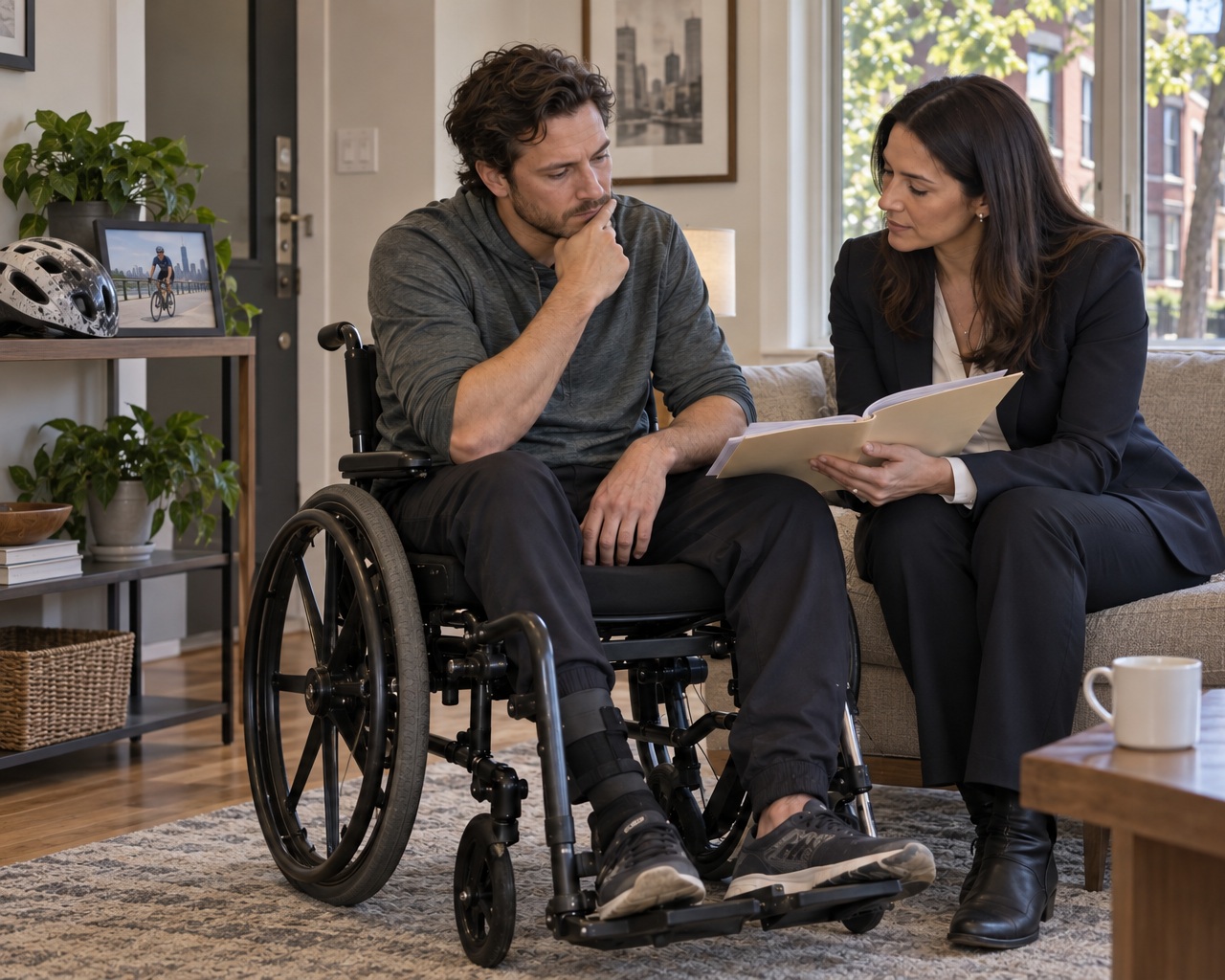
A Bicycle Crash Can Change Independence in Seconds
A spinal cord injury after a bicycle crash can affect far more than a rider's ability to walk. Depending on the level and severity of the injury, it may change hand function, balance, endurance, bowel and bladder control, employment, transportation, family roles, and the ability to complete everyday tasks without assistance.
For an injured cyclist, the legal claim must therefore look beyond the first hospital bill. It should document the medical care, rehabilitation, lost income, equipment, home and vehicle changes, personal assistance, and other losses the rider is reasonably expected to face in the years ahead.
A bicyclist can spend years riding to work, training on weekends, carrying a bicycle up apartment stairs, and moving through Chicago without thinking about what it means to live independently. One driver who fails to yield, turns across a bike lane, opens a door into the rider's path, or strikes the cyclist from behind can change that life in an instant.
How Can a Bicycle Crash Damage the Spinal Cord
A cyclist does not have a vehicle frame, seat belt, or airbag to absorb the force of a collision. When a rider is struck or thrown from a bicycle, the neck or back may bend violently. Vertebrae can fracture, discs can move into the spinal canal, and swelling or bleeding can place pressure on the spinal cord.
Spinal cord injuries may include:
- Spinal cord contusion. A direct impact bruises the cord and may cause inflammation, weakness, sensory changes, or paralysis.
- Spinal cord compression. A fractured vertebra, displaced disc, swelling, or bleeding places pressure on the cord and interferes with nerve signals.
- Incomplete spinal cord injury. Some communication remains between the brain and the body below the injury, but the cyclist may have weakness, reduced sensation, impaired coordination, or partial paralysis.
- Complete spinal cord injury. Motor function and sensation are lost below the level of injury, potentially resulting in paraplegia or tetraplegia.
- Central cord syndrome. Damage to the central portion of the spinal cord often causes greater weakness in the arms and hands than in the legs.
- Anterior cord syndrome. Damage to the front portion of the spinal cord can impair movement and the ability to feel pain and temperature below the injury.
The level and completeness of the injury can affect nearly every part of rehabilitation and long-term independence. Two cyclists with spinal cord injuries may have very different abilities, complications, and future needs.
Why Walking Again Does Not Always Mean Full Independence
Recovery is not measured only by whether a person can stand or take steps. Independence can depend on hand function, balance, endurance, transfers, pain, muscle control, bowel and bladder management, and the ability to repeat ordinary tasks throughout a full day.
A cyclist who can walk a short distance may still need a wheelchair for longer trips. Someone who can dress independently may need help transferring into a shower. A person who can drive may require adaptive controls or a vehicle that accommodates a wheelchair. Another rider may complete basic activities of daily living but remain unable to return to the same job or ride a bicycle again.
These distinctions matter in an injury claim. An insurer may point to a milestone such as walking again while overlooking fatigue, fall risk, pain, limited hand function, or the assistance still required at home. The evidence should show the difference between partial recovery and the independence the cyclist had before the collision.
What Long-Term Needs May Follow a Spinal Cord Injury
The initial hospitalization may be only the beginning. Depending on the injury and the rider's prognosis, future needs may include:
- Home and vehicle modifications, including ramps, widened doorways, roll-in showers, lifts, accessible living space, and adaptive driving controls.
- Personal care assistance for bathing, dressing, transfers, meal preparation, transportation, bowel and bladder management, or other daily activities.
- Adaptive equipment and replacement costs for wheelchairs, cushions, braces, transfer equipment, and other devices that wear out or must change over time.
- Ongoing medical and rehabilitation care, including physical therapy, occupational therapy, specialist treatment, medications, and care for secondary complications.
- Lost income and earning capacity when the cyclist cannot return to the same occupation, hours, advancement path, or expected working life.
- Replacement services for transportation, childcare, cleaning, home maintenance, and responsibilities the injured person previously handled.
These losses may be recoverable in an Illinois personal injury case when the crash caused them and the evidence supports them. A careful damages analysis looks forward instead of treating bills already received as the full measure of the claim.
How Are Future Medical Care and Lifetime Costs Proven
Long-term damages cannot rest on guesswork. They must be supported by medical and financial evidence tied to the injured person.
Treating physicians and rehabilitation professionals can explain the diagnosis, prognosis, functional limitations, and expected care. In a serious case, a life-care planner may organize anticipated treatment, equipment, assistance, and related needs over the cyclist's lifetime. A vocational rehabilitation expert may evaluate whether the rider can return to the same work or what employment remains realistic. An economist may calculate future earning losses and the present value of projected costs.
A bicycle injury lawyer's role is to connect those pieces. The medical prognosis should align with the life-care plan. Work restrictions should align with the vocational analysis. Most importantly, the cyclist's actual daily limitations should be documented so an insurance company does not get to define the loss.
Why an Early Settlement May Miss the Full Cost
Insurance companies may make settlement offers before the medical picture is clear. That is especially risky after a spinal cord injury because rehabilitation takes time, complications can develop, and a person's eventual level of function may not be known during the first weeks or months.
An early offer may include the hospitalization and treatment already received while omitting future rehabilitation, replacement equipment, personal assistance, lost earning capacity, home modifications, and other needs that have not yet been fully evaluated.
After a claim is settled and a release is signed, the injured cyclist generally cannot reopen the case simply because the lifetime cost proves greater than expected. Before accepting an offer, the rider should understand the medical evidence, available insurance coverage, and reasonably anticipated future losses.
Why Evidence of Daily Life Matters
A medical record can establish a diagnosis, but it may not capture everything the injury has taken away. The cyclist may no longer be able to commute by bicycle, ride with friends, carry groceries upstairs, lift a child, sleep comfortably, use public transportation without help, or manage household responsibilities independently.
That is why a strong damages case may draw on employment records, photographs, family testimony, rehabilitation notes, receipts for adaptive equipment, evidence of home modifications, and descriptions of the cyclist's activities before the crash. Together, this evidence shows the human difference between life before the collision and life after it.
How Long Does an Injured Cyclist Have to File an Illinois Lawsuit
Illinois generally requires an action for personal injury to be filed within two years after the cause of action accrued under 735 ILCS 5/13-202. Shorter deadlines or different rules may apply in particular circumstances, including claims involving a local public entity or employee, a minor, delayed discovery, or another statutory exception. The deadline should be evaluated for the specific case by an experienced Illinois personal injury attorney.
The filing deadline is not the only reason to act promptly. Traffic-camera and business-surveillance video may be overwritten, witnesses may become difficult to locate, vehicles and bicycles may be repaired, and physical evidence may disappear. Early investigation can preserve crash evidence while the medical team continues to evaluate the cyclist's prognosis.
Source: Illinois General Assembly, 735 ILCS 5/13-202
What Should a Cyclist Do After a Crash With Possible Spinal Cord Damage
Numbness, tingling, weakness, loss of coordination, difficulty walking, severe neck or back pain, or a change in bowel or bladder control after a bicycle crash requires prompt medical attention. The rider should clearly report every neurological symptom so medical providers can determine what examination, imaging, and treatment are appropriate.
The cyclist should also follow recommended treatment and specialist referrals. Spinal cord symptoms and function may change over time, and the medical record is one of the primary ways to document the condition and its effect on daily life.
Medical care comes first, but the legal investigation should not be ignored. Before giving a recorded statement or accepting a settlement, an injured rider can speak with an attorney who understands bicycle crashes and catastrophic neurological injuries. Counsel can investigate fault, preserve evidence, identify available insurance coverage, and begin documenting losses that may continue long after rehabilitation ends.
Medical resource: Model Systems Knowledge Translation Center guide to spinal cord injury recovery and rehabilitation
Frequently Asked Questions About Bicycle Crash Spinal Cord Injuries
Can a cyclist have a spinal cord injury without complete paralysis
Yes. An incomplete spinal cord injury may leave some movement or sensation below the level of injury. The rider may still experience weakness, numbness, pain, poor coordination, fatigue, bowel or bladder dysfunction, or reduced independence.
Can someone walk and still have a serious spinal cord injury claim
Yes. The ability to walk does not answer whether the person can work, transfer safely, drive, use stairs, manage personal care, tolerate a full day of activity, or live without assistance. The claim should reflect the cyclist's complete functional loss, not one recovery milestone.
What compensation may be available after an Illinois bicycle crash
Depending on the facts and proof, damages may include past and future medical expenses, lost wages, diminished earning capacity, pain and suffering, disability, disfigurement, emotional distress, and the value of necessary services or assistance. The available recovery also depends on liability, insurance coverage, and the evidence in the individual case.
Who may be responsible for a bicycle crash that causes a spinal cord injury
Potentially responsible parties may include a negligent driver, the driver's employer, a rideshare or commercial transportation company where legally appropriate, a vehicle or component manufacturer, or a public or private entity responsible for a dangerous condition. Responsibility depends on how the crash happened and the applicable law.
When should an injured cyclist contact a lawyer?
As soon as reasonably possible after urgent medical needs are addressed. Prompt action gives the legal team a better opportunity to preserve video, inspect the bicycle and vehicles, locate witnesses, obtain electronic data, and identify every potential source of insurance.
Chicago Bicycle Injury Lawyers Who Understand What Is at Stake
Keating Law Offices is a leading personal injury law firm in Chicago and throughout Illinois. Firm founder Michael Keating is currently Chair of the Transportation Committee for the Illinois Trial Lawyers Association. He was also the longtime Chair of the Bicycle Litigation Committee for the American Association for Justice. Our attorneys ride, advocate for cyclists, and have spent years representing injured bicyclists throughout Chicago and Illinois. We understand how one negligent act can take away the independence a rider built an entire life around.
Our bicycle accident case results include seven-figure recoveries for injured cyclists and their families, as well as a jury verdict for a Chicago cyclist who sustained spinal injuries after being doored in a bike lane. Prior results do not guarantee a similar outcome; every case depends on its facts and evidence.
If you or someone you love suffered a spinal cord injury in a bicycle crash, our Chicago bicycle accident lawyers can investigate what happened, deal with the insurance companies, and build the evidence needed to show what the injury has changed and what it may cost in the future. Contact Keating Law Offices for a free consultation.
Client Review
“From the initial consultation to the final settlement, this law office exceeded my expectations. Their knowledge of accident law is impressive, and they got me compensated faster than I thought possible. A+ team!” — Jedrzej P., five-star review