The ABC7 I-Team Found the Same Violations the City Thought Were Fixed. Cyclists and Pedestrians Are Still at Risk.
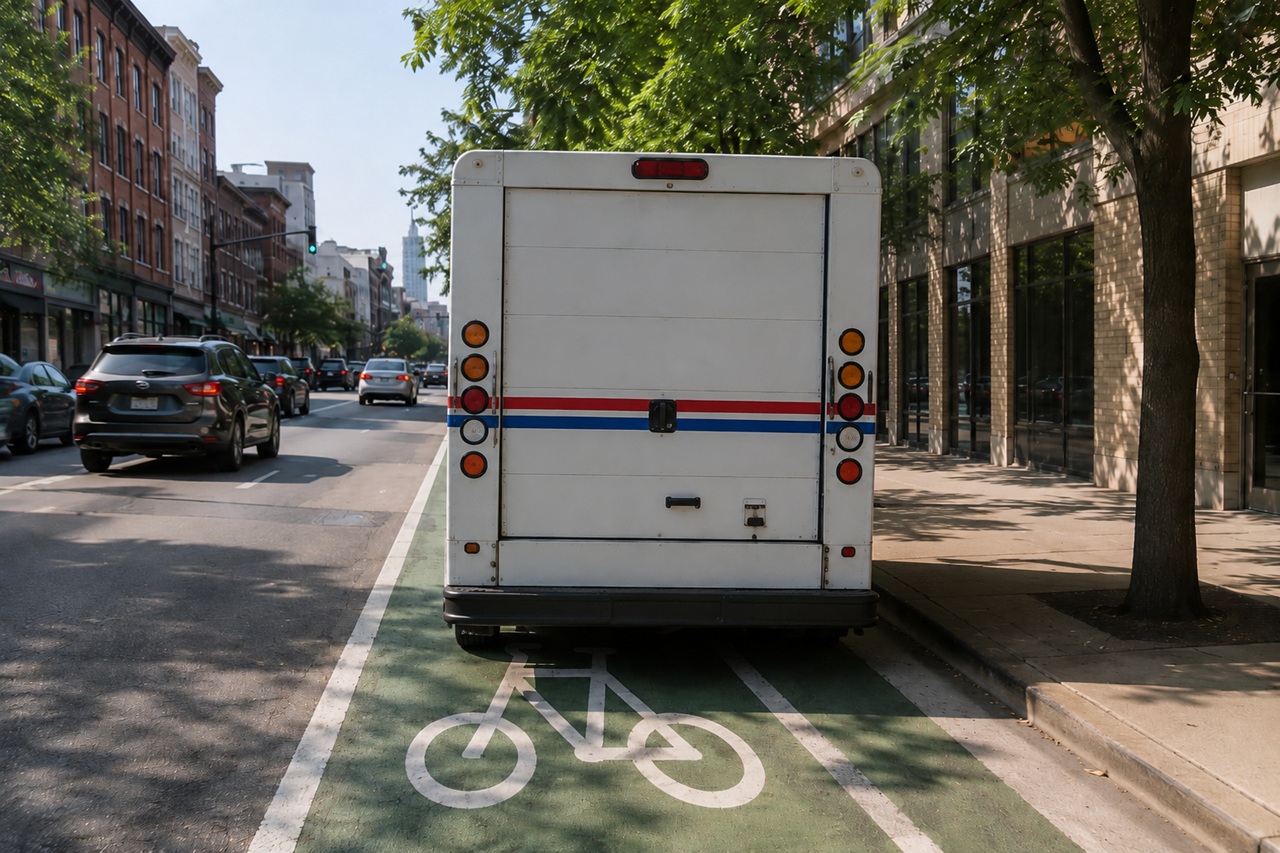
Federal and local officials say illegally parked U.S. Postal Service trucks are once again creating safety hazards in Chicago’s Lincoln Park neighborhood, months after city leaders believed the problem had been resolved. According to ABC7 Chicago’s I-Team, USPS trucks near the Lincoln Park Annex have recently been seen blocking bike lanes, stop signs, crosswalks, fire hydrants, bus stops, and other restricted areas.
These examples of post office vehicles blocking bicycle lanes are unfortunately part of an ongoing problem: many delivery vehicles like Amazon, UPS, and FedEx trucks use bicycle lanes in Chicago as their own parking lanes.
These scofflaws create real danger for people walking and biking through one of Chicago’s busiest neighborhoods. When a truck blocks a bike lane, a cyclist may be forced into moving traffic. When a truck blocks a stop sign or crosswalk, drivers, cyclists, and pedestrians may lose the clear sightlines they need to avoid a crash.
If a blocked bike lane, obstructed crosswalk, or illegally parked vehicle causes a crash, injured cyclists may have legal options. The Chicago bicycle accident lawyers at Keating Law have fought for injured cyclists since 2008. Attorney Michael Keating didn't just help change Illinois bicycle law. He is himself a cyclist and helped write and advocate for many of the laws that are in place today to protect vulnerable users of the roadways.
What Did The ABC7 I-Team Find In Lincoln Park?
ABC7 reported that this is the third time its I-Team has covered USPS truck parking hazards near the Lincoln Park Annex. The outlet first reported on the issue in October 2025, followed up in December 2025, and returned to the story in July 2026 after the same concerns resurfaced.
The latest reporting found postal trucks illegally parked in paid parking spaces, in front of fire hydrants, at bus stops, and in other restricted areas. Earlier ABC7 reporting found trucks blocking bike lanes, stop signs, and crosswalks while reducing visibility for drivers and pedestrians near two schools.
Alderman Timmy Knudsen told ABC7 that the renewed violations were frustrating because officials had taken USPS at its word that the problem would be fixed. U.S. Rep. Mike Quigley also said his office would continue pushing USPS management until the issue is resolved.
Why Are Blocked Bike Lanes So Dangerous?
A blocked bike lane isn't just a minor inconvenience. It can force a cyclist to decide, in seconds, whether to stop abruptly, merge into traffic, ride into a vehicle lane, or squeeze through a narrow space beside a large truck. Any of those choices can lead to a crash.
Chicago law recognizes that danger. Under Chicago Municipal Code § 9-40-060, drivers generally may not drive, stand, park, or place a vehicle in a bike lane in a way that impedes bicycle traffic. The same ordinance says vehicles parked in violation of the bike-lane parking rule can be subject to immediate towing.
Because Chicago bike lanes must be kept clear and safe, repeated obstructions are not just frustrating for riders. They create predictable crash risks that can seriously injure cyclists who are simply trying to use the space the city set aside for them.
What Other Parking Hazards Did ABC7 Report?
The ABC7 report also described USPS trucks parked in front of fire hydrants, at bus stops, near stop signs, and around crosswalks. Those locations matter because they affect emergency access, traffic flow, pedestrian safety, and driver visibility.
Chicago Municipal Code § 9-64-100 prohibits parking within 15 feet of a fire hydrant, within 20 feet of certain crosswalks where official signs are posted, and within 30 feet of an official traffic signal or stop sign on the approaching side. Those rules exist because blocked sightlines can turn ordinary street movements into dangerous conflicts.
For cyclists, the risk isn't only limited to the truck itself. A blocked stop sign can lead a driver to enter an intersection without stopping. A blocked crosswalk can push pedestrians into less visible positions. A blocked bus stop can force transit riders, cyclists, buses, and cars into the same narrow space.
Why Does The Enforcement Gap Matter?
ABC7 reported that Chicago police can't ticket or tow postal trucks and that only Postal Service police have that authority. That leaves residents, cyclists, pedestrians, and local officials in a difficult position when the same hazards keep appearing.
That enforcement gap doesn't make the danger disappear. When a postal truck blocks a bike lane, the cyclist still has to react in real time. When a truck blocks a crosswalk, a pedestrian still has to navigate around it. When a truck blocks visibility at an intersection, everyone approaching that intersection faces more risk.
It also doesn't mean legal accountability is impossible if someone is hurt. Enforcement and injury claims are different issues. A ticket may help prove a violation, but a civil claim can still be built with photos, video, witnesses, roadway evidence, and proof that the parked truck created a foreseeable hazard.
Can You Bring A Claim If A USPS Truck Causes A Crash?
If an operator of a USPS truck injures you, you can absolutely bring a claim. But because the claim is against the “United States of America,” specific laws apply under what is known as the Federal Tort Claims Act (FTCA). These claims involving USPS can involve federal procedures that are different from ordinary injury cases. The U.S. Department of Justice explains that Standard Form 95 is used to present claims against the United States under the Federal Tort Claims Act for property damage, personal injury, or death allegedly caused by a federal employee’s negligence or wrongful act within the scope of federal employment.
USPS regulations also state that an administrative claim is filed when USPS receives Standard Form 95 or other written notice of the incident, along with a claim for money damages in a specific amount for injury, property loss, personal injury, or death.
These rules are strict. Claims involving USPS vehicles or USPS-created hazards may have administrative filing requirements and deadlines that do not apply in the same way to ordinary bicycle accident claims. That's why a cyclist or pedestrian hurt near a postal truck should get legal advice quickly before evidence disappears or a deadline is missed.
Keating Law has litigated numerous FTCA cases in Federal court and is familiar with the policies and procedures in place to proceed with one of these claims against the Federal government.
What If Another Driver Hit You After A Postal Truck Blocked The Bike Lane?
Some crashes may involve more than one responsible party. For example, a USPS truck may block the bike lane, forcing a cyclist into traffic, while another driver strikes the cyclist after failing to slow down, yield, or give enough space.
In that situation, the investigation shouldn't stop with the driver who made contact. It should look at every factor that contributed to the crash, including the parked vehicle, the driver’s actions, roadway design, sightlines, video footage, and whether the hazard was part of a repeated pattern.
Determining fault in a Chicago bicycle accident can be complicated when multiple people or entities helped create the danger. The right legal strategy depends on how the crash unfolded and what evidence is available.
What Specific Hazards Do Illegally Parked Trucks Create For Cyclists?
The conditions ABC7 documented in Lincoln Park create specific crash risks that cyclists and pedestrians experience as immediate threats.
- Bike Lane Obstructions: A cyclist who encounters a truck parked in the bike lane may have to merge into moving traffic, stop suddenly, or ride around the obstruction with little warning.
- Blocked Stop Signs and Intersections: A truck blocking a stop sign or intersection sightline can prevent drivers from seeing traffic controls, cyclists, pedestrians, or cross traffic.
- Blocked Crosswalks: A truck stopped in or near a crosswalk can force pedestrians into unsafe positions and make them harder for drivers to see.
- Reduced Visibility Near Schools: ABC7 previously reported the problem near two schools, where blocked sightlines can be especially dangerous for children walking or biking.
- Dooring Risk: Delivery workers opening truck doors near a bike lane can create a sudden hazard for approaching cyclists.
- Reactive Driving: Drivers and cyclists who encounter a blocked lane may make abrupt movements, increasing the risk of secondary collisions.
These aren't just abstract safety concerns. They're the kinds of street conditions that can cause a cyclist to be sideswiped, doored, struck at an intersection, or thrown from a bike.
What Evidence Can Help After A Crash Near An Illegally Parked Truck?
Evidence matters even more when a crash involves a federal vehicle, an obstructed bike lane, or more than one possible at-fault party. The sooner evidence is gathered, the harder it becomes for any responsible party to deny what happened.
Important evidence may include:
- Photos of the Truck: Capture the truck’s position, license plate, USPS markings, blocked bike lane, blocked crosswalk, obstructed stop sign, or other hazard.
- Time and Location Details: Record the exact intersection, date, time, direction of travel, and where the truck was parked.
- Video Footage: Doorbell cameras, business cameras, dashcams, bus cameras, and nearby surveillance systems may show the obstruction or crash.
- GPS and Ride Data: Bike computers, fitness apps, and phone location data may help show the cyclist’s route, speed, and movement before impact.
- Witness Statements: Other cyclists, pedestrians, neighbors, bus riders, or business owners may have seen the truck, the obstruction, or the crash.
- Medical Records: Prompt treatment helps connect the injuries to the crash and document the full impact.
This evidence can help show that the illegally parked vehicle was not just present. It helped create the unsafe condition that led to the injury.
What Should Chicago Cyclists Do Right Now?
Alderman Knudsen told ABC7 that residents who see a postal truck illegally parked should call 911 and contact his office directly. Even if Chicago police can't ticket or tow the truck, a 911 call can create a documented record of the violation at a specific time and location.
Cyclists who regularly ride through Lincoln Park can also document recurring hazards. Photos with timestamps, location information, and visible street markings may help show that the problem was known and repeated.
If you're hurt in a crash where a parked vehicle played a role, do not give a recorded statement to an insurance company before getting legal advice. Understanding how to file a bike accident insurance claim in Chicago is only one part of the process. A lawyer can also evaluate whether a federal claim, a driver claim, or another source of recovery may apply.
Keating Law Is Ready To Help Injured Chicago Cyclists
If you were injured while riding in Lincoln Park or anywhere in Chicago because of a blocked bike lane, obstructed crosswalk, or any other hazardous condition caused by an illegally parked vehicle, we want to hear from you.
Keating Law has fought for Chicago cyclists for more than 15 years. We know how to investigate these crashes, identify all sources of accountability, and move quickly when a claim may involve a federal vehicle or time-sensitive evidence.
Our contingency fee means there are no upfront costs, and you owe us nothing unless we recover compensation for you. Contact us today for a free consultation.
"The insurance company tried to claim I was 50% at fault — the attorneys at KLO continued to fight until the insurance company finally acknowledged the driver lied about what happened and accepted full responsibility for my injuries and damages. I was glad to have KLO on my side!" - J.M., ⭐⭐⭐⭐⭐